
Bhutan
Next  |
| Facts & Figures | |
|---|---|
Ruler: King Jigme Khesar Namgyal Wangchukin (2006) Prime Minister: Lyonpo Jigme Thinley (2008) Total area: 18,147 sq mi (47,000 sq km) Population (2009 est.): 691,141 (growth rate: 1.2%); birth rate: 20.0/1000; infant mortality rate: 9449.3/1000; life expectancy: 66.1; density per sq km: 50 Capital and largest city (2003 est.): Thimphu (official), 60,200 Monetary unit: Ngultrum |

| ||
|
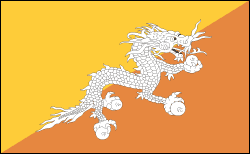
Geography
Mountainous Bhutan, half the size of Indiana, is situated on the southeast slope of the Himalayas, bordered on the north and east by Tibet and on the south and west and east by India. The landscape consists of a succession of lofty and rugged mountains and deep valleys. In the north, towering peaks reach a height of 24,000 ft (7,315 m).Government
Bhutan's first national elections in March 2008 marked the country's shift from an absolute monarchy to a constitutional monarchy.History
Although archaeological exploration of Bhutan has been limited, evidence of civilization in the region dates back to at least 2000 B.C. Aboriginal Bhutanese, known as Monpa, are believed to have migrated from Tibet. The traditional name of the country since the 17th century has been Drukyul, Land of the Drokpa (Dragon People), a reference to the dominant branch of Tibetan Buddhism that is still practiced in the Himalayan kingdom.For centuries, Bhutan was made up of feuding regions until it was unified under King Ugyen Wangchuck in 1907. The British exerted some control over Bhutan's affairs, but never colonized it. Until the 1960s, Bhutan was largely isolated from the rest of the world, and its people carried on a tranquil, traditional way of life, farming and trading, which had remained intact for centuries. After China invaded Tibet, however, Bhutan strengthened its ties and contact with India in an effort to avoid Tibet's fate. New roads and other connections to India began to end its isolation. In the 1960s, Bhutan also undertook social modernization, abolishing slavery and the caste system, emancipating women, and enacting land reform. In 1985, Bhutan made its first diplomatic links with non-Asian countries.
A pro-democracy campaign emerged in 1991, which the government claimed was composed largely of Nepali immigrants. As a result, some 100,000 Nepali civil servants were either evicted or encouraged to emigrate. Most of them crossed the border back into Nepal, where they were housed in UN-administered refugee camps. They continue to languish there a decade later.


